Get Consultation from Experts
First Chat Free
Sign In
Enter your mobile number to continue
By signing in, you agree to our Terms Of Use and Privacy Policy
Download Our App For Better Experience


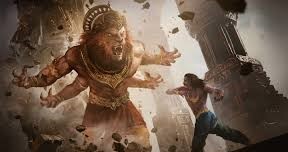
The manifestation of Lord Narasimha, the fourth incarnation of Lord Vishnu, stands as one of the most dramatic, awe-inspiring, and philosophically profound episodes in Hindu tradition. It is not merely a tale of divine wrath or supernatural intervention, but a deeply symbolic narrative that reveals the omnipresence of the Divine, the limits of ego, and the ultimate triumph of truth over arrogance.
Lord Narasimha, depicted as a being with the body of a man and the head of a lion, emerges as a force that transcends all categories of existence. His form itself is a statement—a declaration that the Divine cannot be confined within human logic, language, or understanding. This incarnation serves as a reminder that whenever righteousness (dharma) is threatened and devotion is oppressed, the Divine manifests in ways that defy all expectations.
The story begins with the demon king Hiranyakashipu, a powerful ruler who performed intense penance to please Lord Brahma. As a reward, he received a seemingly invincible boon that made him almost immune to death. He could not be killed by any man or animal, neither during the day nor at night, neither inside nor outside, neither on the ground nor in the sky, and not by any weapon.
Empowered by this boon, Hiranyakashipu’s arrogance grew beyond limits. He declared himself to be a god and demanded that everyone worship him. His ego became so overwhelming that he sought to eliminate all forms of devotion to Lord Vishnu, whom he considered his enemy.
This phase of the story represents the dangerous rise of unchecked ego—the belief that power and control can override universal laws. Hiranyakashipu’s tyranny symbolizes the human tendency to forget humility when granted success and authority.
In stark contrast to his father stands Prahlada, Hiranyakashipu’s own son. From a young age, Prahlada displays unwavering devotion to Lord Vishnu. Despite being raised in an environment that opposes divine worship, he remains steadfast in his faith.
Prahlada’s devotion is not influenced by fear or desire for reward; it is pure, unconditional, and deeply rooted in truth. He sees the presence of Vishnu in everything—in nature, in people, and within himself.
This contrast between father and son highlights one of the central themes of the story: the eternal conflict between ego and devotion, between ignorance and awareness.
Hiranyakashipu is enraged by Prahlada’s devotion. He tries repeatedly to change his son’s beliefs through persuasion, threats, and punishment. When all attempts fail, he resorts to violence.
Prahlada is subjected to numerous forms of torture:
He is thrown from a cliff
Poisoned
Trampled by elephants
Exposed to fire
Yet, in every instance, he remains unharmed. His faith acts as a shield, protecting him from harm.
These episodes are deeply symbolic. They illustrate that true devotion creates an inner strength that cannot be destroyed by external forces. Prahlada’s calmness and resilience demonstrate that faith is not weakness but the highest form of power.
One day, in a moment of intense anger, Hiranyakashipu confronts Prahlada and asks him:
"Where is your God? Is He present everywhere?"
Prahlada calmly replies that Vishnu exists in every particle of the universe.
Hiranyakashipu, in a fit of rage, points to a pillar and asks if Vishnu is present there as well. When Prahlada answers yes, Hiranyakashipu strikes the pillar with his weapon.
This moment is pivotal. It represents the ultimate challenge posed by ego to the Divine—the demand for proof, the attempt to confine the infinite within the limits of perception.
From the broken pillar emerges Lord Narasimha in a form that defies all logic—a being who is neither man nor beast, but both. His appearance is terrifying, radiant, and overwhelming.
This manifestation is not random; it is perfectly aligned with the conditions of Hiranyakashipu’s boon. Narasimha appears at twilight, a time that is neither day nor night. He drags the demon to the threshold of a doorway, which is neither inside nor outside. He places him on his lap, which is neither ground nor sky, and uses his claws—not weapons—to kill him.
This moment is often described as a divine “checkmate”—a perfect resolution that demonstrates how divine wisdom transcends human cunning. No matter how cleverly one tries to manipulate reality, the truth cannot be defeated.
Lord Narasimha’s form is both terrifying and compassionate. To the wicked, he is destruction itself—a force that annihilates ego and injustice. To the devoted, he is a protector, a source of comfort, and a symbol of divine love.
After killing Hiranyakashipu, Narasimha remains in a state of intense fury. The gods themselves are unable to calm him. It is only when Prahlada approaches him with devotion and humility that Narasimha’s anger subsides.
This transition from wrath to calmness reflects the dual nature of the Divine:
As a destroyer of evil
As a protector of righteousness
The story of Narasimha is rich with symbolism and deeper meaning:
The emergence of Narasimha from a pillar proves that God exists everywhere, even in places we least expect.
Hiranyakashipu’s downfall shows that arrogance and misuse of power inevitably lead to destruction.
Prahlada’s unwavering devotion demonstrates that faith is stronger than fear.
The story illustrates that justice may be delayed, but it is always delivered in the most precise and appropriate manner.
Narasimha’s form challenges the boundaries of logic, showing that the Divine cannot be confined to human understanding.
Even in today’s world, the story of Lord Narasimha holds immense relevance. It speaks to individuals facing oppression, injustice, or overwhelming challenges.
In a world where power is often misused and truth is sometimes suppressed, the story reminds us that:
No injustice goes unnoticed
No act of devotion is wasted
No force can defeat truth
It encourages individuals to remain steadfast in their values, even when circumstances seem unfavorable.
On a deeper level, Narasimha represents the awakening of inner consciousness. Hiranyakashipu symbolizes the ego that denies the presence of the Divine, while Prahlada represents the soul that recognizes it.
The pillar symbolizes the human heart—seemingly ordinary but capable of revealing the Divine when broken open through faith and surrender.
The story of Lord Narasimha is not just a tale of divine intervention; it is a timeless lesson on the nature of reality, faith, and justice. It teaches us that the Divine is always present, watching, guiding, and protecting those who remain true to dharma.
It reminds us that no matter how powerful evil may appear, it cannot withstand the force of truth and righteousness. The roar of Narasimha echoes across time as a declaration that justice will always prevail.
Ultimately, this story inspires us to cultivate faith, humility, and courage in our own lives. It encourages us to trust that even in our darkest moments, the universe is aligned in favor of truth—and when the time comes, it will manifest in ways beyond our imagination to restore balance and harmony.