Get Consultation from Experts
First Chat Free
Sign In
Enter your mobile number to continue
By signing in, you agree to our Terms Of Use and Privacy Policy
Download Our App For Better Experience


The Mahabharata stands as one of the greatest epics ever composed in human history, not only in terms of its immense scale but also in its profound depth of philosophical, moral, and spiritual insight. At its core, the Mahabharata is a sweeping narrative that captures the complexity of human life, centering around the intense and tragic conflict within the Kuru dynasty. This conflict unfolds between two groups of cousins—the five noble Pandava brothers and the one hundred ambitious and power-driven Kauravas.
However, to describe the Mahabharata merely as a story of war or family rivalry would be to vastly underestimate its significance. It is, in truth, a monumental exploration of Dharma—the concept of righteousness, duty, and moral order that governs both individual lives and the universe itself. Through its intricate storytelling and deeply layered characters, the Mahabharata presents a vivid portrayal of how human choices, guided or misguided by dharma, ultimately shape destiny and define the course of history.
The Mahabharata begins with the lineage of the Kuru family, a royal dynasty ruling over Hastinapura. The seeds of conflict are sown long before the actual war takes place. The blind king Dhritarashtra, father of the Kauravas, and his younger brother Pandu, father of the Pandavas, represent two branches of the same family tree. While the Pandavas are known for their virtues—truthfulness, humility, strength, and adherence to dharma—the Kauravas, led by Duryodhana, embody ambition, jealousy, and an unyielding desire for power.
From a young age, tension grows between the two groups. The Pandavas excel in their training, especially Arjuna, who becomes a master archer under the guidance of Guru Dronacharya. This excellence fuels Duryodhana’s jealousy, which gradually evolves into hatred. Despite numerous attempts to reconcile and maintain peace, including wise counsel from elders like Bhishma and Vidura, the divide between the two sides becomes irreparable.
The pivotal turning point occurs during the infamous game of dice, where Yudhishthira, the eldest Pandava, is deceitfully defeated by Shakuni, Duryodhana’s uncle. In this game, the Pandavas lose everything—their kingdom, their wealth, and even their dignity. Draupadi, their shared wife, is humiliated in the royal court, marking one of the darkest moments in the epic. This event not only deepens the injustice but also sets the stage for the eventual war.
Following the dice game, the Pandavas are exiled to the forest for thirteen years, including one year of living in disguise. This period of exile is not merely a time of suffering but also one of growth, reflection, and preparation. The Pandavas gain spiritual wisdom, divine weapons, and inner strength.
Meanwhile, Duryodhana consolidates his power, refusing to return even a small portion of the kingdom to the Pandavas after their exile ends. Numerous attempts at peace are made, including Lord Krishna’s diplomatic mission to Hastinapura, but all efforts fail due to Duryodhana’s arrogance and refusal to compromise.
Thus, the stage is set for the great war of Kurukshetra—a battle that is not just physical but deeply symbolic of the eternal struggle between righteousness and unrighteousness.
The Kurukshetra war is the central event of the Mahabharata, involving vast armies, legendary warriors, and divine interventions. However, beyond its grandeur and scale, the battlefield serves as a metaphor for the human condition.
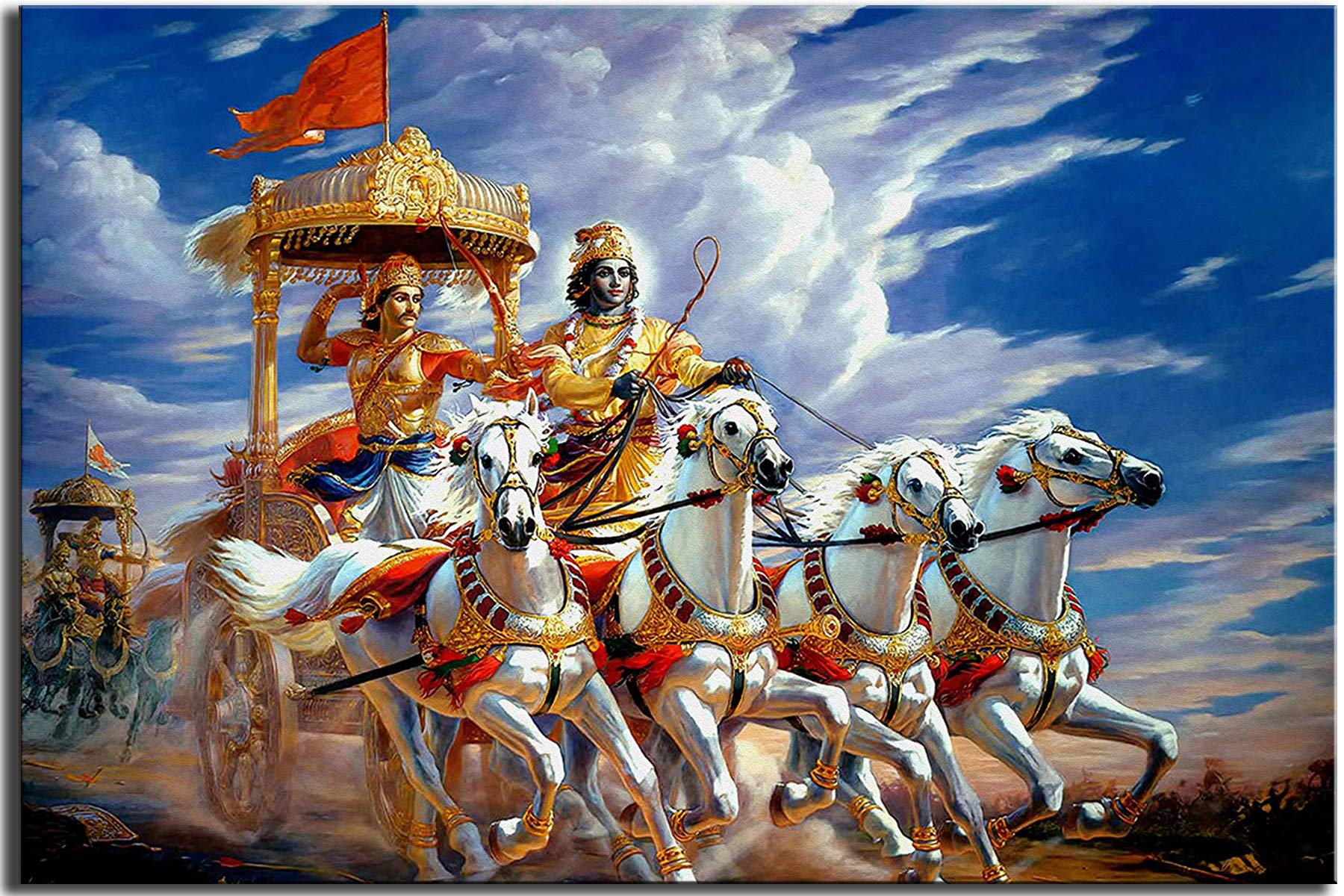
One of the most significant moments occurs just before the war begins, when Arjuna, standing on the battlefield, is overcome with doubt and sorrow. Seeing his own relatives, teachers, and friends on both sides, he questions the very purpose of the war. He is torn between his duty as a warrior and his compassion as a human being.
It is at this critical juncture that Lord Krishna, serving as Arjuna’s charioteer, delivers the teachings of the Bhagavad Gita—one of the most revered spiritual texts in the world.
The Bhagavad Gita is a philosophical dialogue that addresses the deepest questions of existence. Krishna explains to Arjuna the nature of the soul (Atman), the importance of performing one’s duty (Karma), and the path to liberation (Moksha).
Krishna emphasizes that the soul is eternal and indestructible, and that death is merely a transition. He teaches that one must act without attachment to the results, focusing instead on righteous action. This concept of Nishkama Karma—selfless action—is one of the central teachings of the Gita.
Through this divine guidance, Arjuna overcomes his doubts and prepares to fulfill his duty as a warrior, not out of personal desire but as a means to uphold dharma.
One of the most remarkable aspects of the Mahabharata is its portrayal of characters who are deeply human and morally complex. Unlike many traditional stories that present clear distinctions between good and evil, the Mahabharata explores the gray areas of human nature.
Bhishma, bound by his vow of loyalty to the throne, fights for the Kauravas despite knowing their actions are unjust.
Karna, a noble and generous warrior, remains loyal to Duryodhana out of gratitude, even when it leads him to oppose his own brothers.
Gandhari, the mother of the Kauravas, embodies both strength and sorrow, as she witnesses the destruction of her sons.
Arjuna, despite his valor, struggles with inner conflict and moral dilemmas.
These characters reflect the reality that human beings are not purely good or evil but are shaped by circumstances, choices, and internal struggles.
The Kurukshetra war lasts for eighteen days and results in massive destruction. Almost all the great warriors on both sides are killed. The victory of the Pandavas comes at a tremendous cost, leaving them with a sense of emptiness and grief.
Yudhishthira, despite becoming king, is deeply troubled by the loss of life and questions the value of the war. This highlights one of the central messages of the Mahabharata—that even righteous victory carries consequences.
The Mahabharata is not just an ancient epic; it is a timeless guide to understanding life and human behavior. Some of its key lessons include:
Dharma is not always straightforward. It requires wisdom, context, and careful judgment.
Every decision, whether good or bad, shapes the future.
Duryodhana’s downfall is a result of his unchecked ego and greed.
Krishna’s teachings emphasize the importance of fulfilling one’s responsibilities.
Every individual faces moral dilemmas and must find their own path.
Even in today’s fast-paced and complex world, the Mahabharata remains deeply relevant. Its themes of leadership, ethics, family conflict, and personal growth resonate across cultures and generations.
The struggles faced by its characters mirror the challenges of modern life—balancing ambition with morality, making difficult decisions, and dealing with the consequences of our actions.
The Bhagavad Gita, in particular, continues to inspire millions, offering guidance on how to live a meaningful and balanced life.
The Mahabharata is far more than a story of war—it is a profound exploration of the human experience. Through its vast narrative and deeply philosophical teachings, it reveals the complexities of dharma, the consequences of choices, and the eternal struggle between good and evil.
It teaches us that the path of righteousness is often difficult and requires sacrifice, but it is ultimately the path that leads to truth, balance, and spiritual growth. The epic reminds us that while we may face challenges and conflicts in life, it is our adherence to dharma that defines our character and shapes our destiny.
In the end, the Mahabharata stands as a timeless testament to the enduring power of truth, the importance of moral courage, and the ultimate victory of righteousness over injustice.